Last Update: 02.07.2014, Photos 2,3,4,5 and text.
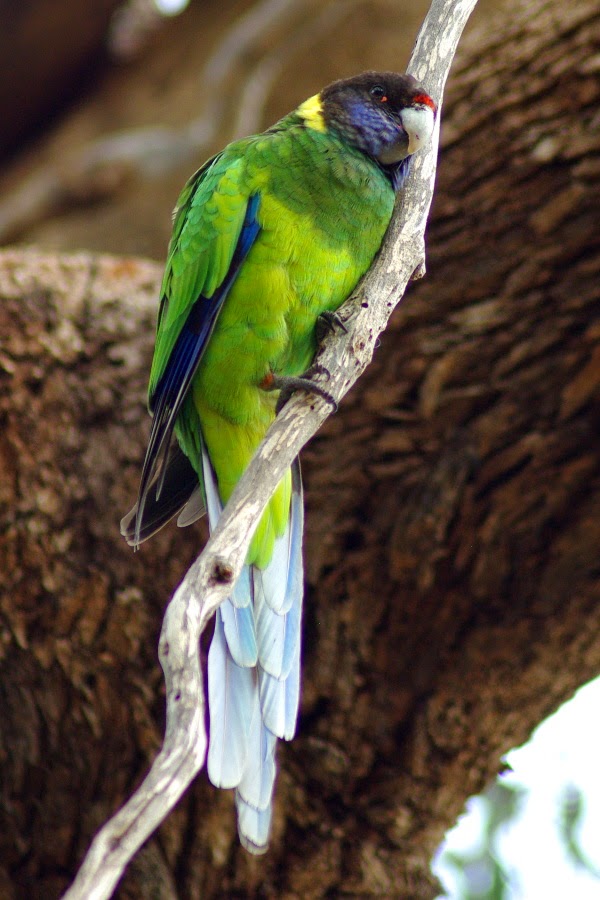
The name of Twenty-Eight Parrot is derived from its distinctive (twenty eight) call.
The Australian Ringneck is a large parrot, differing in size and plumage in different regions. There are four subspecies, in two main groups. All are mostly green, with an obvious yellow band on the hind-neck. Members of the Mallee group have a mainly green head and neck.
The Malee Ringneck, subspecies bernardi, has more varied green and blue body, with more yellow underneath and a red frontal band.
The Cloncurry subspecies mackgillivrayi has much more yellow and pale turquoise around the face.
The Port lincoln group all have dark hoods and are mainly green.
None of them is not described in this blog, but the Australian ringneck is unmistakable with a yellow hind collar on a mostly green bird.
The Australian Ringneck is endemic to Australia. The Mallee group is found in arid eastern Northern Territory, north-western Queensland and inland eastern Australia.
The Port Lincoln group is in central and western arid Australia. Ringnecks are generally absent from coastal areas in the eastern states.
Australian Ringnecks are found in pairs or small flocks over lightly timbered areas, open woodlands and tree-lined watercourses. They are mainly resident, but may move in arid areas in response to rainfall.
Australian Ringneck feed mainly on the ground, but also in trees and shurbs, usually in the morning and late afternoon, resting in the heat of the day. They eat seeds, and some fruits, flowers, nectar and their larvae. They often feed on split grain on roadsides.
Australian Ringneck lay their eggs in hollows in living or dead trees on a base or on rotting wood dust. They enter trough a hole in the trunk, a knothole ore spount. Yhe female incubates the eggs while being fed by the male and she may leave the nest for a short time to be fed by him. The young are fed by both parents and often can be seen at the mouth of the hollow.
In the East of Australia, numbers are effected by clearing of mallee scrub and woodland for agriculture. Ringnecks were considered vermin in Western Australia and were shot as orchard pest in open shooting seasons. Aviary escapes are seen around urban areas in the east.
Photo- Jozef Skubin. 1. Kwinana town 07.03.2013. 2,3,4,5,6 Walter Point Swan River 29.06.2014
Text references.
Australian Birds, Their Nests and Eggs.
Field guide to Australian Birds.
Handbook of Australian, New Zealand and and Antarctic Birds
Parrots and Pigeons of Australia
Wikipedia