Monday, 11 March 2013

Pacific Black Duck


Like other ducks and geese, this very common Australian duck is a strong swimmer. It most fund near the water and normally feeds on aquatic plant seeds, insects, and crustaceans, but is also accused by farmers of damaging crops.
More brown then black, it has a dark line edged in white from the bill, trough to the eye.

Photos taken, 1,2, Tomato Lake, Perth W.A. 3,4 Herdsman Lake    

Osprey


This bird of prey is commonly observed along the coast, on the margins of rivers, and on offshore islands.
Despite a similar appearance, it's only distantly related to the eagles, hawks and kites.
Its diet consist almost exclusively of fish, which is grasps with its talons from the water during flight.
Ospreys possess a number of unique adaptations, including a closable nostril, a riversible outer toe, and spines  under the foot.
They build large stick nests high on rocky headlands, in trees, or on electricity transmission towers.

Photos taken, 1,2, Point Heathcote reserve. Perth W.A.        

Australian Shelduck

    Male 

 Female


The Australian Shelduck breeds in Southern Australia and Tasmania. In the winter many birds move further north than the breeding range.
As with other shelducks, the species has favorite moulting grounds, such as lake George in New South Wales, where sizeable concentrations occur.
The Australian Shelduck's primary habitat is lakes in fairly open country. It makes its nest in three holes in banks or similar location.

Photos taken 1, Tomato Lake, Perth W.A.

Great Cormorant


Cormorants are persecuted by some fishers due to their proficiency in catching fish.
They can distort the lenses in their ayes and thus see well both above and below water.
This one inhabits most coastal and inland waterways.
The wings lack waterproofing, reducing buoyancy and helping the bird to reach the riverbed to feed.

Photos taken 1,2 Swan river, Queen Elizabeth quay.

Sunday, 10 March 2013

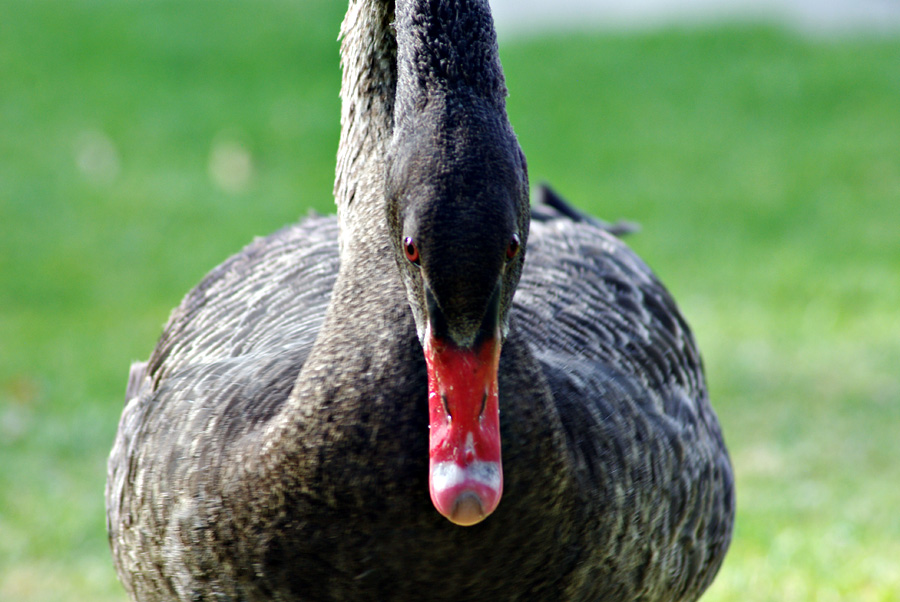
Black Swan


The Black Swan is national bird of Western Australia and emblem on the W.A. flag.
This large bird has a long slender neck, a red bill and black plumage but with white wing tips that are noticeable during flight.
After the breeding season, thousands of Swans gather in wetlands, feeding on aquatic plants and marsh grasses.
Their distinctive trumpeting call is sometimes heard when they are flying in a V formation at night.

Photos taken 1,2,3,4,5,6, Swan River, Victoria park, Perth W.A.

Magpie lark


This bird is concpicuous Australian bird of small to medium size, also known as the Mudlark in Western Australia and Victoria, the Murray magpie in South Australia, and as the Peewee in New South Wales and Queensland.
It spends most of time foraging for insects on the ground.

Photos taken 1,2, Tomato lake, Perth W.A.

Australian Pelican


In addition to coastal lagoons, this bird can be found almost anywhere in Australia where sufficient water exist to support fish and crustaceans.
It's easily identifiable, whether soaring in the air, or floating on water.
Pelicans like a free feed and often wait for handouts near boat ramps.

Photos taken 1,2, Swan river, Belmont. W.A. 3,4,5 Penguin Island